Reactant Orientation
Overview
Using artificial force induced reaction (AFIR) method, following objectives can be met in an automated manner:
Orient the reactant geomtries
Predict the unknown reactions between two reactants
Search for reaction for bond formation between two atoms in two different molecules
The method involves applying an artificial force between different parts of a molecule or between multiple molecules to induce a reaction and guide it towards a specific product.
Check the Input and Visualizer section for the allowed input types and how to upload the files.
How it works
The reactant orientation compute engine generates a certain number of trial orientations of the input reactant geometries based on the range of the user-provided force parameters. Upon generation, the trial orientation geomtries will undergo geometry optimization either with Hybrid ML or GFN2_XTB as chosen by the user.
Input Fields
Total charge of the reactant 1 molecule (e.g., 0)
Spin multiplicity = 2S+1 (e.g., 1 for singlet)
Total charge of the reactant 2 molecule (e.g., 0)
Spin mulitplicity = 2S+1 (e.g., 1 for singlet)
Minimum artificial force
Maximum artificial force parameter
Number of trial orientations to generate and start with
Software for geometry optimization of the trial orientations i.e., Hybrid ML or GFN2-XTB.
Finally, click the Run Reactant Orientation button to start the simulation.
Output Details
The following options are available to explore and save the results of your geometry optimization:
Trial orientations are visualized on the left side of the visualizer.
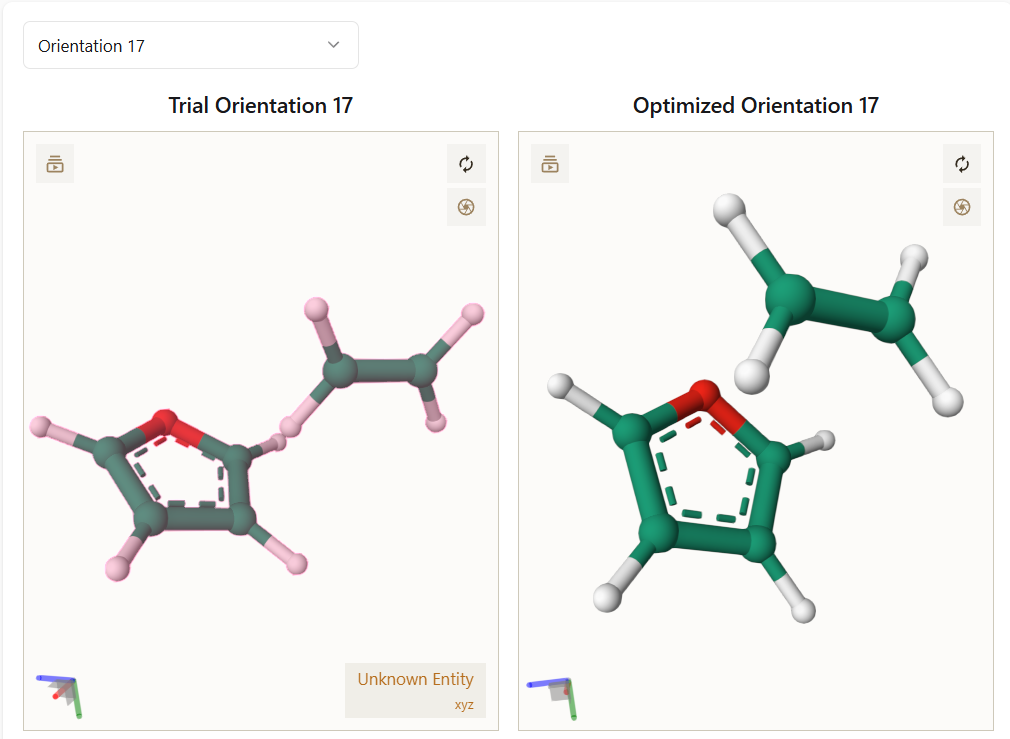
Figure: Interface of different trial and optimized oriented geometries.
Optimized orientation geometries are visualized on the right half of the visualizer.
In the bottom right corner, you can save the “Metadata”.